What Happens When You Can Actually Watch Your Team Think
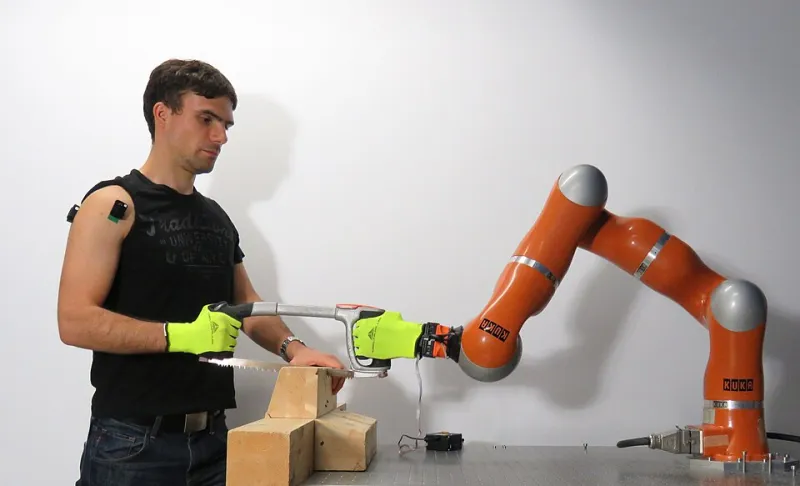
Photo: Luka Peternel, CC BY-SA 4.0, via Wikimedia Commons
There's a moment that anyone who's used a real-time collaborative writing tool knows well. You open a shared document, start typing, and then — a cursor appears on the other side of the screen. Someone else is there. They're reading what you're writing. Maybe they're adding to it, or maybe they're just watching your thoughts take shape in real time.
It sounds like a small thing. It isn't.
That little blinking cursor represents something that most of us spent years missing without even realizing it: the sense that we're actually working with someone, not just exchanging outputs.
The Long Shadow of "Send and Wait"
For most of knowledge work's history, collaboration has been fundamentally asynchronous. You write something, you send it, you wait. The other person reads it, responds, sends it back. You're not really working together — you're taking turns.
Email codified this pattern so deeply that it became invisible. Even as tools evolved, the rhythm stayed the same. Draft, review, respond, repeat. The document travels between people like a baton in a relay race, and the work only moves when someone picks it up.
This approach has real advantages. Asynchronous work respects time zones, deep focus, and individual working styles. Not everything needs to be done simultaneously, and there's genuine value in giving people space to think before they respond.
But it also creates friction that's easy to underestimate. Every handoff is a potential delay. Every round of revisions adds another lap to the relay. And somewhere in all those back-and-forths, the original intent of a project can get diluted, distorted, or just plain lost.
Real-Time Changes the Rhythm
Synchronous collaboration doesn't replace asynchronous work — but it changes what's possible when you need momentum.
When two people are editing a document at the same time, the feedback loop collapses from hours to seconds. A question that would have kicked off a three-email thread gets answered in a comment resolved before the other person even finishes their sentence. A direction that feels off gets course-corrected before it's fully developed, not after it's been polished and presented.
For distributed teams — especially those spread across the US and beyond — this matters enormously. Real-time collaboration creates pockets of genuine synchronicity in workdays that are otherwise full of gaps and delays. It's not a perfect substitute for sitting in the same room, but it's a lot closer than most people expected it to be.
The Psychology of Presence
Here's something worth sitting with: there's a real psychological difference between working alone and working alongside someone, even digitally.
Research on "co-presence" — the sense of being with someone even at a distance — suggests that it affects motivation, accountability, and even creative output. When you know someone else is in the document with you, you're subtly more engaged. You're less likely to drift. You feel the low-level social pressure of not wanting to look like you're not contributing.
This isn't manipulation — it's just how humans work. We're wired to perform differently in social contexts than in isolation. Real-time collaboration tools tap into that wiring in a way that async tools simply can't.
There's also something genuinely energizing about watching a collaborator's ideas develop in real time. You catch the thought before it's been edited into its final form. You see the false starts and the pivots. That visibility builds a kind of intellectual intimacy that's hard to manufacture through polished back-and-forth exchanges.
What This Means for Remote-First Culture
For companies that are fully remote or remote-first — a category that now includes a huge chunk of the US workforce — culture is always the hard problem. It's easy to build processes. It's hard to build connection.
Real-time text collaboration isn't a magic solution to that problem, but it contributes something real. Shared documents become shared spaces. Writing together becomes a form of thinking together. The act of co-creating something, even something as mundane as a project brief or a meeting agenda, creates a tiny thread of shared experience.
Over time, those threads add up. Teams that regularly collaborate in real time tend to develop sharper shorthand, stronger working relationships, and a more coherent sense of collective voice. They know how each other thinks because they've literally watched each other think.
For remote teams trying to maintain cohesion across distances, that's not nothing. That's actually a lot.
The Shift Is Already Happening
It would be easy to frame real-time collaboration as the future of work. But honestly, for a lot of teams, it's already the present.
The tools are there. The habits are forming. What's still catching up is the cultural permission to embrace synchronous collaboration fully — to stop treating it as a feature and start treating it as a workflow.
That means rethinking when to write together versus when to write alone. It means building team rituals around shared documents the way previous generations built them around meetings. It means recognizing that the act of sharing text in real time isn't just convenient — it's connective.
The cursor on the other side of the screen isn't just a technical indicator that someone else is online. It's a signal that you're not working alone. In a world where remote work can feel isolating and async communication can feel impersonal, that signal turns out to matter more than anyone would have predicted.
Write together. The rest follows.